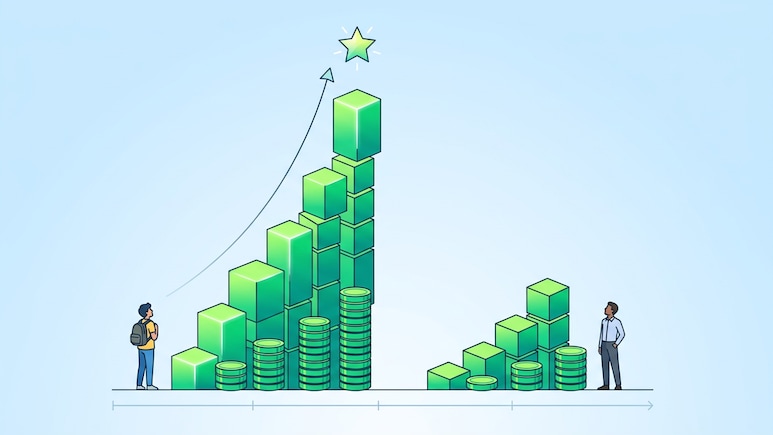
Let us talk about that glorious moment when your very first proper salary lands in your bank account. It is genuinely magical, is it not? After years of surviving on tight student budgets, managing unpredictable part-time gigs, and thinking twice before ordering an extra side of chips, suddenly having a steady stream of disposable income feels like you have conquered the world.

Setting up an automated monthly investment means you build wealth quietly.
Photo Credit: Pexels
The temptation, naturally, is to upgrade your life immediately. You want to travel, buy that wardrobe you have been eyeing for months, and perhaps finally treat your parents to a lovely dinner without nervously checking the prices on the right side of the menu. And you absolutely should do those things. You have worked hard, and you have earned it.
But as an older sibling who has made their fair share of money mistakes, I want to let you in on the greatest financial secret nobody teaches you in school. It is not about timing the stock market, being a mathematical genius, or coming from a wealthy family.
Also Read: The 50/30/20 Rule: How To Budget For Your Lifestyle Without Feeling Guilty
It is simply about starting right now.
You see, in your twenties, time is your greatest asset. It is the one thing you have in absolute abundance, and in the financial world, time translates directly into a phenomenon called compounding. Understanding the power of compounding is the single most important step you will ever take toward your long-term financial freedom.
So, grab a cup of tea, and let us break down exactly how starting to invest at 22 rather than waiting until you are 30 changes absolutely everything about your future.
What Exactly Is Compounding?
If you ever ask a finance expert how to build wealth, they will inevitably throw the word "compounding" at you. To put it simply and without the banking jargon: compounding is just earning interest on your interest.
When you invest, your principal amount earns returns. Instead of taking those returns out and spending them, you leave them right where they are. In the next period, you earn returns on both your original investment and the returns you accumulated. Over time, this compounding interest snowball grows larger and larger.
Imagine you are standing at the top of a snow-covered hill. You pack a tiny handful of snow into a small ball and gently roll it down the slope. As it rolls, the snow catches more snow. Then that new layer of snow catches even more snow. By the time it reaches the bottom of the hill, your tiny snowball has transformed into a massive, unstoppable boulder.
That is your money. When you invest, your money makes a little bit of profit. The next year, that profit makes its own profit. Over decades, this creates a massive snowball effect that does the heavy lifting for your wealth creation. It allows your money to work incredibly hard so you do not have to.
The Tale Of Two Friends: 22 vs. 30

Do not wait for a perfect moment or a stock market crash; starting today means your money has more time to grow.
Photo Credit: Pexels
To truly grasp why those early years are so critical, let us look at a practical, real-life scenario. Meet our two friends: Aisha and Rahul. Both want to retire comfortably by the age of 60, but they take very different approaches to getting there.
Aisha's Approach (The Early Starter)
Aisha gets her first job at 22. She is not earning a fortune, but she decides to set aside just ₹5,000 every single month. She treats this like a non-negotiable monthly bill, just like her Netflix subscription or her phone bill. She invests it quietly in equity mutual funds and simply gets on with enjoying her twenties.
Rahul's Approach (The Late Bloomer)
Rahul, on the other hand, decides to wait. At 22, he thinks, "I am too young to worry about retirement! I will start when I am 30 and earning more." True to his word, on his 30th birthday, Rahul begins investing. Because he knows he has started late, he decides to invest double what Aisha does. He commits to ₹10,000 every month.
The Mid-Life Financial Showdown
Let us assume both of their investments grow at an average rate of 10% per year. Let us fast-forward to their 60th birthdays and look at the numbers.
| Feature/Metric | Aisha (The Early Starter) | Rahul (The Late Bloomer) |
|---|---|---|
| Starting Age | 22 years old | 30 years old |
| Monthly Contribution (SIP) | ₹5,000 | ₹10,000 |
| Total Investment Horizon | 38 years | 30 years |
| Total Out-of-Pocket Contribution | ₹22.8 Lakhs | ₹36.0 Lakhs |
| Assumed Annual Return Rate | 10% | 10% |
| Final Wealth at Age 60 | ₹2.65 Crores | ₹2.27 Crores |
| The Result | Earns ₹38 Lakhs more | Invests ₹13.2 Lakhs more but gets less |
Take a moment to let that sink in.
Aisha invested significantly less of her own hard-earned money (₹22.8 Lakhs compared to Rahul's ₹36 Lakhs). Yet, she ended up with nearly ₹38 Lakhs more than him.
Why? Because Aisha gave her money eight extra years to roll down that snowy hill. Those eight years in her twenties were far more powerful than the extra money Rahul threw at the problem in his thirties. Rahul had to work twice as hard and dig much deeper into his own pockets just to play catch-up, and he still fell short. That is the incredible, mathematical reality of starting to invest at 22.
The Cost of Waiting for the "Perfect Time"
One of the biggest myths that stops young people from starting their investment journey is the belief that you need a lot of money to start. You might be telling yourself, "I will start investing when I get my next promotion," or "I will wait until I have ₹50,000 saved up."
This is a trap. In the world of investing, when you start is far more important than how much you start with. Every month you delay is a month of compounding you can never get back. You cannot rewind the clock, no matter how rich you become later in life.
It is perfectly fine to start small. Even ₹500 or ₹1,000 a month is enough to build the habit. Think of it as planting a tiny seed. It does not look like much today, but eventually, it will provide the shade you sit under.
Busting The Jargon: How To Actually Start

Investing ₹5,000 a month starting at age 22 builds a much larger nest egg than investing ₹10,000 a month starting at age 30.
Photo Credit: Pexels
The financial industry loves complicated words. It makes them sound smart, but it often makes the rest of us feel intimidated. Let us break down a few key terms into plain English so you can take action today.
- SIP (Systematic Investment Plan): This is just a fancy term for a monthly subscription for your future self. Just like money automatically leaves your account for your favourite streaming platform, an SIP automatically moves a fixed amount of your money into an investment every month. It puts your wealth-building on autopilot.
- Mutual Funds: Imagine you want a slice of pizza, but you want a bite of Margherita, Pepperoni, and Veggie Supreme all at once. Buying a whole pizza of each is too expensive. A mutual fund is like buying one mixed slice. It is a basket of different company shares managed by an expert, meaning your money is spread out safely rather than betting on just one company.
- Equities: This simply means owning tiny fractions (shares) of real businesses. Over long periods, successful businesses grow, and as they grow, the value of your tiny fractions grows too.
Your Step-By-Step Game Plan For Your Twenties
If you are in your twenties, here is your straightforward, zero-stress action plan to harness the power of compounding:
- Build a safety net first: Before you put your money into the market, save up enough to cover three to six months of your basic living expenses. Keep this in a normal, easily accessible bank account for emergencies—like a medical issue or an unexpected career transition.
- Set up an automatic SIP: Pick a monthly amount you will genuinely not miss. If that is ₹1,000 a month, fantastic. Set up an automatic SIP into a broad-market mutual fund. Ideally, schedule this transaction for the day after your monthly salary arrives so you "pay yourself first."
- Step it up gradually: Every time you get a pay rise or a bonus, increase your SIP amount. If your salary goes up by ₹5,000, put ₹2,000 of that raise into your investments and enjoy spending the rest. This prevents "lifestyle creep" from quietly eating your future wealth.
- Practice active patience: The hardest part of investing is doing absolutely nothing. Do not obsess over daily market news or panic when the market takes a temporary dip. The market will go up, and the market will go down. Your only job is to stay consistent and keep rolling that snowball.
Making The First Move
The transition from a saver to an investor is a profound shift in mindset. It is the moment you realise that you do not just have to work hard for your money; your money can actually start working hard for you.
Historically, investing meant filling out endless physical paperwork, visiting intimidating bank branches, and dealing with pushy agents trying to sell you complex products you did not understand.
Thankfully, wealth creation is no longer an exclusive club. Today, building your financial future is quite literally at your fingertips. Platforms like Groww have completely revolutionised the way we invest by stripping away the jargon, eliminating the physical paperwork, and making the entire process completely transparent.
With Groww, you can open an investment account in minutes from your smartphone, explore mutual funds in plain English, and set up your very first SIP with just a few simple taps. There are no hidden fees to worry about, and the interface is as intuitive as your favourite social media app.
Your 22-year-old self has the one asset that the wealthiest 50-year-olds in the world would give all their money for: Time. Do your future self a massive favour. Start today, start small, let the magic of compounding do its work, and watch your financial future unfold beautifully. Click here to open your Groww account today.
Frequently Asked Questions (FAQs)
1. Is compounding guaranteed?
While returns in equity markets fluctuate in the short term, historical data shows that over long periods (10 to 15+ years), the market tends to rise, allowing compounding to work effectively.
2. What if I can only invest ₹500 a month?
Start anyway! The habit of disciplined saving is just as valuable as the money itself. As your income grows, you can easily scale up your contributions.
3. Can I pause or change my monthly SIP if I hit a tight spot?
Absolutely. One of the best things about modern SIPs is their flexibility. If you have an unexpected expense or find yourself temporarily short of cash, you can easily pause, decrease, or increase your SIP amount through your investing app without any penalties. You are always in complete control of your cash flow.
4. Should I wait for a stock market crash to start investing?
It is incredibly tempting to try and "time" the market, but even seasoned professionals get it wrong. Trying to wait for the absolute lowest point usually means you end up sitting on the sidelines for months or years, missing out on valuable compounding time. Remember: time in the market beats timing the market every single time.
5. Do I need to pay taxes on my compounded earnings every year?
No, you do not! With mutual funds, you only pay tax when you actually sell (or redeem) your investments. As long as your money stays invested and continues to compound undisturbed, you do not owe any annual tax on those paper gains. This tax-free growth phase is another reason why leaving your money alone is so incredibly powerful.
Disclaimer: This article may include references to or features of products and services made available through affiliate marketing campaigns. NDTV Convergence Limited (“NDTV”) strives to maintain editorial independence while participating in such campaigns. NDTV does not assume responsibility for the performance or claims of any featured products or services.
