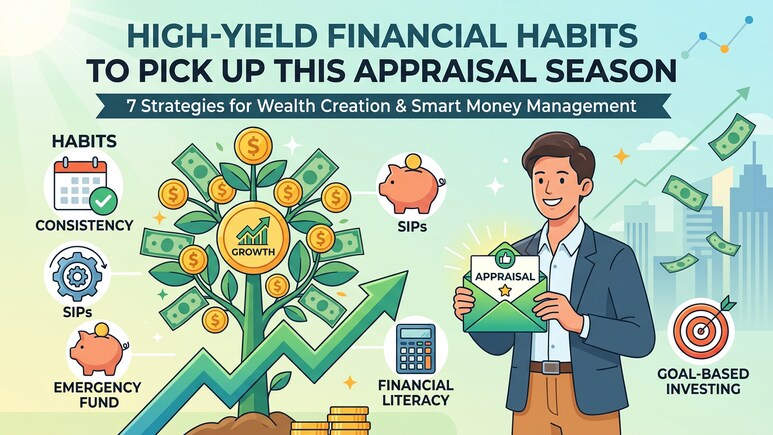
The calendar invite arrives, the meeting concludes, and the numbers are finally confirmed: your annual appraisal has resulted in a well-deserved pay rise or a substantial yearly bonus. It is a moment of genuine validation. After twelve months of hard work, late nights, and meeting relentless deadlines, the immediate impulse is to celebrate. An upgraded holiday, a newer car model, or simply treating yourself to a luxury you have been putting off suddenly feels entirely justified. You have earned it.

Take the effort out of wealth creation by following these high-yielding financial habits.
Photo Credit: Pexels
However, the period immediately following a salary increase is the single most critical window for your long-term wealth creation. While treating yourself is necessary for your well-being, the way you handle this new influx of cash dictates your financial trajectory for years to come.
Also Read: The 50/30/20 Rule: How To Budget For Your Lifestyle Without Feeling Guilty
Think of this advice as a conversation with a financially savvy older sibling: if you want to ensure your appraisal actually upgrades your net worth and not just your wardrobe, this is the perfect time to build "high-yield" habits.
Wealth creation is not an exclusive, members-only club. It is accessible to anyone willing to put basic systems in place. We are not just talking about high-yield investments, but high-yield behaviours that will pay you dividends for decades. Here are the top financial habits you need to pick up this appraisal season.
7 High-Yield Financial Habits To Pick Up This Appraisal Season
1. Give Your Pay Rise a "Cooling-Off" Period
Human beings are incredibly susceptible to a subtle psychological phenomenon known as "lifestyle creep". This is the silent trap where your everyday spending mysteriously rises to perfectly match your new income. If you get a 15% pay rise, you might start buying premium groceries, taking a few more taxis, or upgrading your phone contract. Before you realise it, your baseline expenses have crept up by 15%, leaving you feeling just as strapped for cash at the end of the month as you were before your promotion.
The most powerful habit you can build right now is the cooling-off period. When your new salary hits your bank account, pretend for the first two months that it hasn't. Continue living on your previous, lower budget. Take the exact difference, every single rupee of that increase, and route it directly into your savings or investment accounts. Once those two months are up, you can deliberately decide how much of the increase you want to allocate to lifestyle upgrades (perhaps 5%) whilst permanently assigning the rest to your future self.
2. Treat Your Emergency Fund Like a Monthly Bill
If you do not have an emergency fund, your entire financial house is built on a fragile foundation. An emergency fund is your ultimate financial defence mechanism. It is a stash of highly accessible cash meant only for true crises, such as sudden medical bills, urgent home repairs, or unexpected redundancy.
If your appraisal has prompted you to take on a larger rent or a new car lease, your monthly living costs have increased. Consequently, the total size of your emergency fund needs to increase as well. A solid rule of thumb is to aim for three to six months' worth of essential living expenses. Make funding this account non-negotiable. Treat it exactly like your council tax, your electricity bill, or your mortgage payment. It is a bill you pay to your own peace of mind, and it ensures you never have to sell your investments at a loss just to cover an unexpected expense.
3. Embrace the Magic of "SIPs"

Appraisal season is the ultimate window to upgrade your net worth
Photo Credit: Pexels
If you want to grow your wealth but feel entirely overwhelmed by the idea of monitoring the stock market or trying to guess the perfect time to buy, you need to make peace with the concept of a SIP.
A Systematic Investment Plan (SIP) simply means putting away a small, fixed amount of money into an investment fund every single month, exactly like a subscription for your future wealth.
Why is this a high-yield habit? Because it completely removes human emotion and guesswork from the equation. You do not have to worry about whether the market is having a good day or a bad day. By investing a set amount on the exact same date every month, you naturally buy more investment units when prices are lower, and fewer units when prices are higher. Over time, this averages out the cost of your investments and protects you from market volatility. It is the ultimate "set it and forget it" wealth-building tool.
4. Ruthlessly Target High-Interest Debt
It is vital to understand that not all debt is created equal. A mortgage, for instance, is a long-term commitment tied to a physical asset that generally appreciates over time. Credit card debt or payday loans, however, are financial anchors dragging you down with exceptionally high interest rates.
If you received a lump-sum annual bonus this appraisal season, your first instinct might be to invest it all into the stock market. But if you are currently carrying credit card debt that is charging you upwards of 25% or 30% in annual interest, the absolute smartest "investment" you can make is to pay that balance off immediately. There is no legitimate, low-risk investment on the planet that will guarantee you a 30% return, so eliminating that high-interest debt is a guaranteed, instant win for your net worth. Make it a permanent habit to clear these toxic balances aggressively before trying to build a complex investment portfolio.
5. Name Your Money (Goal-Based Investing)
Saving money just for the vague sake of "having savings" can feel incredibly uninspiring. When your money lacks a specific purpose, it is very easy to raid a generic savings account when you want to buy a new laptop or book a spontaneous weekend getaway.
To counteract this, start practising goal-based investing. Give every single rupee a specific job and a distinct name. Instead of a generic pot, label your accounts clearly: "The 2026 International Holiday Fund", "The House Deposit Tracker", or "The Early Retirement Portfolio". When you attach a deeply personal, emotional goal to your money, you are far less likely to interrupt its growth. You aren't just taking money out of a random account; you are actively stealing from your future holiday or your future home. This psychological shift is incredibly powerful.
6. Upskill Your Financial Literacy (And Ignore the Jargon)
The financial industry has a terrible habit of using overly complex language to make simple concepts sound intimidating. Do not let this keep you out of the wealth-building game. Making it a habit to read one personal finance article a week, or listen to one accessible money podcast on your commute, will compound your knowledge drastically over a year.
When you encounter financial jargon, take a deep breath and realise it is usually just a fancy label for a basic, everyday idea.
For example, if you read about a "Bull Market", this is just a colourful way of saying the stock market is feeling highly optimistic and prices are generally going up.
If an article mentions a fund's "AUM" (Assets Under Management), this is merely the total amount of money a specific financial firm is looking after on behalf of all its investors.
Once you strip away the intimidating vocabulary, you will find that the core principles of growing your money are actually straightforward and entirely within your grasp.
7. Automate Absolutely Everything
Willpower is a finite resource. If you have to manually log into your banking app every payday, calculate your budget, and actively transfer money into your various investment accounts, you will eventually slip up. Life gets busy, emergencies happen, or decision fatigue sets in.
The highest-yield habit of all is complete automation. Set up direct debits for the day after your salary hits your account. Automate your SIPs, automate your emergency fund transfers, and automate your debt repayments. By the time you wake up and check your balance, your wealth-building tasks should already be handled by the system. You learn to live comfortably on what is left over, making wealth creation an effortless and invisible part of your background routine.
Take The Next Step Today
Reading about financial habits is a wonderful starting point, but execution is the only thing that actually changes your life. This appraisal season, do not let your extra income sit idle or get swallowed up by creeping lifestyle expenses. You need a platform that aligns with these empowering, jargon-free principles, a place where wealth creation is uncomplicated, transparent, and built for everyone.

Turn your hard-earned career progression into personal wealth with Groww
Photo Credit: Groww
This is exactly where Groww comes in. Designed meticulously with the everyday investor in mind, Groww strips away the intimidating institutional banking noise and makes investing as simple as ordering your Friday night takeaway. Whether you want to set up an automated SIP in a matter of minutes, track your deeply personal goal-based investments, or just explore the market without being bombarded by confusing terminology, Groww provides a clean, intuitive, and highly educational space.
Celebrate your appraisal, be proud of your hard work, and then open an account on the Groww app to ensure your future self gets to celebrate, too.
Frequently Asked Questions (FAQs)
1. What is the 50/30/20 rule, and should I use it after a pay rise?
The 50/30/20 rule is a brilliant budgeting framework where 50% of your income goes to needs (rent, bills), 30% to wants (dining out, hobbies), and 20% to savings and investments. When you get a pay rise, try applying this rule strictly to the new income amount to ensure your savings rate grows alongside your lifestyle.
2. What if my pay rise is quite small? Is it still worth saving or investing?
Absolutely. When it comes to wealth creation, consistency is far more powerful than the initial amount. Even if your pay rise translates to just an extra ₹500 a month, automating that into a SIP makes a massive difference over time thanks to the magic of compounding returns. Never underestimate the power of starting small.
3. Should I invest my annual bonus or put it in savings?
If you have high-interest debt (like credit cards), pay that off first. If you are debt-free but lack an emergency fund, put the bonus into an accessible savings account. If both of those bases are covered, investing your bonus is a fantastic way to accelerate your long-term wealth creation.
4. How do I start investing if I have never done it before?
Start small and keep it simple. You do not need to pick individual stocks. Look into setting up a SIP in a diversified index fund. This allows you to invest a small, comfortable amount each month while you continue to build your financial literacy.
5. How often should I check my investments once I set up a SIP?
As rarely as possible! The true beauty of a Systematic Investment Plan is that it runs quietly in the background. Checking your portfolio every day can lead to unnecessary panic when the market naturally dips. Aim to review your investments perhaps once or twice a year, or when your major financial goals change. Otherwise, let the automation do the heavy lifting.
Disclaimer: This article may include references to or features of products and services made available through affiliate marketing campaigns. NDTV Convergence Limited (“NDTV”) strives to maintain editorial independence while participating in such campaigns. NDTV does not assume responsibility for the performance or claims of any featured products or services.
